




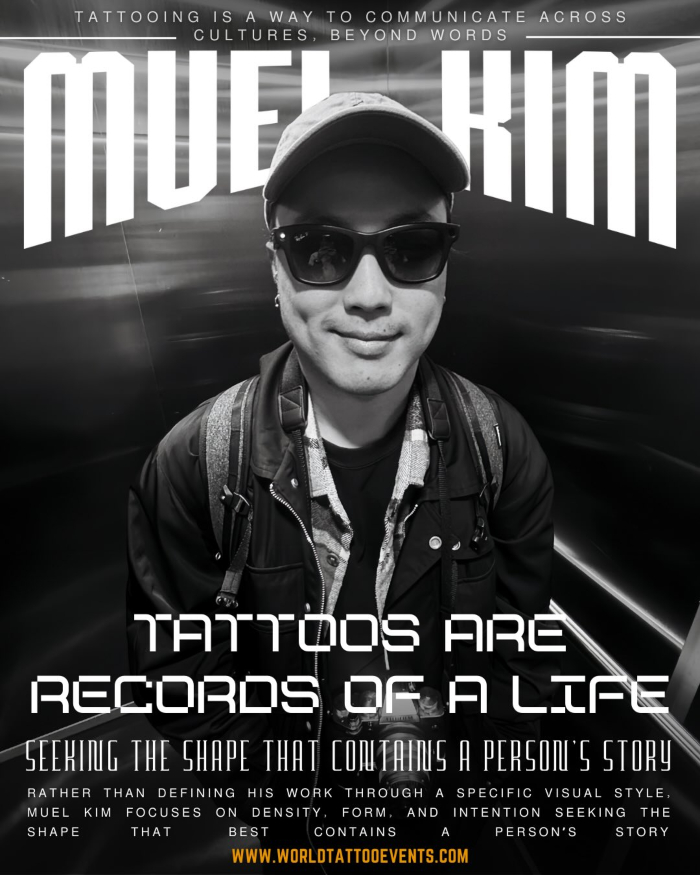
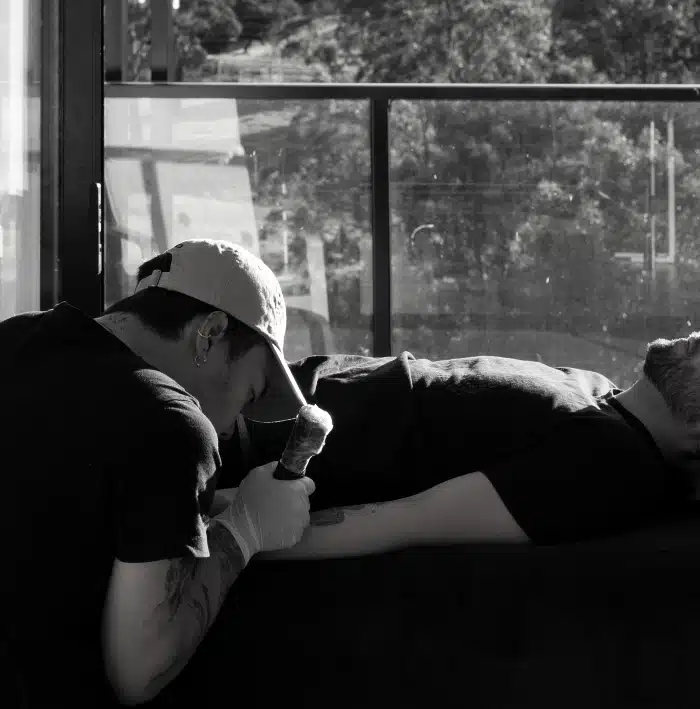
Rather than defining his work through a specific visual style, Muel Kim focuses on density, form, and intention seeking the shape that best contains a person’s story. Each tattoo begins with questions, long conversations, and careful observation, allowing the design to emerge slowly and honestly. Influenced by everyday sensations like wind, light, and ambient sound, his process values presence over speed and depth over aesthetics.
For Muel, tattooing is a way to communicate across cultures, beyond words. He reflects on tattooing as a shared journey, one that requires patience, trust, and accountability from start to finish. Grounded yet quietly philosophical, his perspective reminds us that tattoos are not just marks on the body, but living records, carried through time, places, and personal histories.
Hello Muel Kim, how would you like to introduce yourself?
I work by listening to people’s lives and stories, and translating them into tattoos as records.
Where can your customers find you?
I don’t currently have a fixed base. I’m considering the next city to stay in and preparing the necessary visas.
How would you describe the tattoo scene in your country these days?
I get the impression that tattooing has become an attractive career path for younger generations. I believe more diverse approaches and remarkable artists will continue to emerge naturally.
How would you define yourself in one word?
Freedom.
Where did your fascination for tattoos come from?
It started with curiosity about myself. As I followed what I truly wanted, tattooing became a natural path.

What does tattooing mean to you personally?
It’s a language that allows me to communicate with people from different cultures.
At what point in your life did you decide to become a professional tattoo artist?
Rather than a single moment, it was a gradual realization that this was the most honest way for me to live.
How did your family react when you started a career in tattooing?
They respected my choice as part of my own life.
Did you go through an apprenticeship? How was that experience?
I began by practicing and researching with friends who shared the same dreams. Everyone I’ve met has been a teacher to me, and I believe I’m still in that process.

What did your first tattoo look like?
My own name tattooed on my ankle.
Do you usually do guest spots? If yes, what’s your experience in doing them?
Yes. I’ve traveled between many cities doing guest spots, and those experiences have deeply influenced my perspective and working attitude.
As a Tattoo Artist, what does your daily working routine look like?
I work as part of a two-person team. I’m responsible for tattooing, design, and promotion, while my partner takes care of all other processes. I’m deeply grateful to work alongside someone I trust.
What is one surprising aspect of being a tattoo artist?
Realizing how deeply permanent marks can affect someone’s life. I work with constant focus, hoping each piece leaves a positive impact.

How do you determine the price of a tattoo?
I set prices at a realistic level that allows my travel and work to continue sustainably.
What’s the most rewarding aspect of being a tattoo artist?
Becoming friends with people through tattooing and sharing time and conversations with those whose lives are completely different from mine.
What tools and machines do you prefer to use?
I use the Bishop wireless Wand machine, and depending on the situation, a packer or shader.
What’s your number one aftercare advice for clients?
Please take good care of what we created together. It’s a record of your life.

How would you define your current tattoo style, and how did you end up focusing on it?
Rather than defining my work as a specific visual style, I focus on how to contain a person’s life and emotions. I see tattoos not as decoration, but as records, and I look for the form and density that best fits each story.
Please walk us through your process when you start a new tattoo for your customers.
My work begins with questions. I take time to listen to what values the person has lived by and what they consider important. From those stories, I find the direction of the design.
How does your design process usually develop from start to finish?
Based on the conversation, I create sketches and repeatedly check whether the work truly resembles the person.
How do you stay creatively inspired?
I find inspiration in everyday sensations: Wind, sunlight, and ambient sounds.

Are there any tattoo styles you’d like to explore more?
I’m curious about all styles. I want to become an artist who can understand and express more people.
What’s the most underrated or overrated tattoo style, in your opinion?
Through traveling, I’ve realized that preferences vary greatly by region and culture, so I’m always careful about judging any style.
Are there any tattoos you prefer not to do?
I rarely refuse based on style, but I politely decline requests to replicate another artist’s design.
Do you have sponsors? If yes, what could you tell us about your sponsors?
No, I currently don’t have sponsors.

As a Tattoo Artist, what kind of tattoo ethics is really important to you?
Because tattoos are records that remain in life for a long time, I believe tattoo ethics lie in taking responsibility for both the choice and the entire process.
Being a successful tattoo artist requires many different skills. What’s your favorite way to keep learning?
Whenever I encounter new tools or techniques, I practice and learn them directly.
Do you like to teach or mentor upcoming artists?
I like sharing what I know, but rather than teaching, I prefer exchanging thoughts and finding better ways together.
What’s the best piece of advice you ever received to improve your tattooing technique?
Don’t rush, move slowly.

How do you stay at the top of your game?
By getting plenty of sleep.
What do you think separates a good tattoo artist from a great one?
The attitude of creating new rules and culture.
How do you feel about the growing acceptance of tattoos in society?
I’m grateful for the positive changes, but I also worry that tattoos may be chosen without enough reflection.
What’s the biggest misconception that customers may have about tattoos?
That fine and delicate tattoos will inevitably fade or blur over time.

What’s the biggest trend in tattooing you have noticed in the last 5 years?
Recently, the attitude and perspective behind the work seem to matter more than specific styles.
What’s your view on the rise of AI in tattooing?
It’s a useful tool for research and broadening perspective, but I’m cautious about over-reliance.
What would you change about the tattoo industry?
Personally, I hope there will be more discussion around environments and safety nets that allow traveling guest artists to work more stably.
Do you work on other projects within the tattoo industry?
I’m currently working on a book that records people’s stories.

Do you do other forms of art besides tattooing?
I’ve worked in stone carving and participated in volunteer projects through drawing.
Who are the people you admire the most within the tattoo community?
All artists who dream and turn those dreams into reality.
What’s your experience at tattoo conventions so far?
Working on-site is tense but incredibly valuable. Feeling immediate feedback and respect is rare and meaningful.
How do you usually prepare for a tattoo convention?
I check schedules through the World Tattoo Events website.

What’s your primary reason to attend a tattoo convention?
For the energy of the space and cultural exchange.
What’s your favorite tattoo convention so far? And why?
The Edmonton Tattoo Convention in Canada, my first one. Having many people watch me work was exhilarating.
Have you ever had the opportunity to participate in any tattoo contests?
Not yet, but I’m preparing to do so.
Do you collect tattoos from artists you meet at conventions?
Yes. If I meet an artist whose work or style I want to learn from, I receive tattoos from them.

Is there any tattoo that you have created in your career that you are particularly proud of?
All of them, but the self-tattoo on my leg, the very first one, stands out. Beginnings are hard to forget.
What is your greatest accomplishment as a tattoo artist?
The smile on a client’s face after the work is finished.
What advice would you offer to someone considering a career as a tattoo artist?
If it’s the path you chose, see it through to the end.
What are your goals or dreams for the near future?
I want to create a multidisciplinary cultural space where different artists can gather, exchange, and grow together.
What legacy do you want to leave as a tattoo artist?
I want to leave records of people’s lives. Through traveling, I realized that we all search for answers to similar concerns. If misunderstandings and prejudices born from different environments can be eased, I believe the world can become a little brighter.


Leave A Comment