

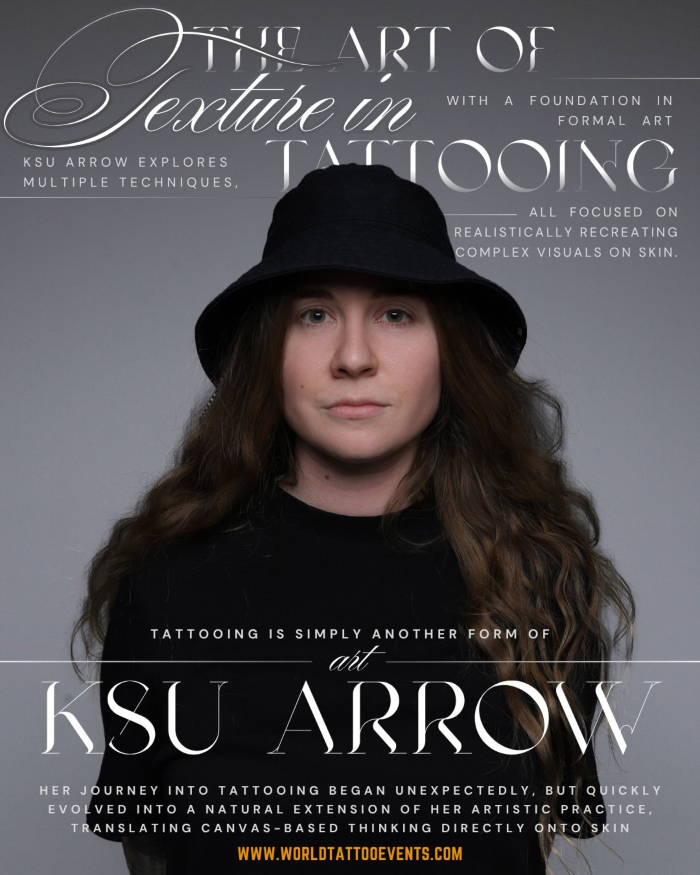
Ksu Arrow is a tattoo and fine artist currently based in Los Angeles, working out of Ink Garden Studio. With a foundation in formal art education, her approach to tattooing is rooted in a clear belief that it is not a subculture or service, but a legitimate part of the art world. Her journey into tattooing began unexpectedly, but quickly evolved into a natural extension of her artistic practice, translating canvas-based thinking directly onto skin.
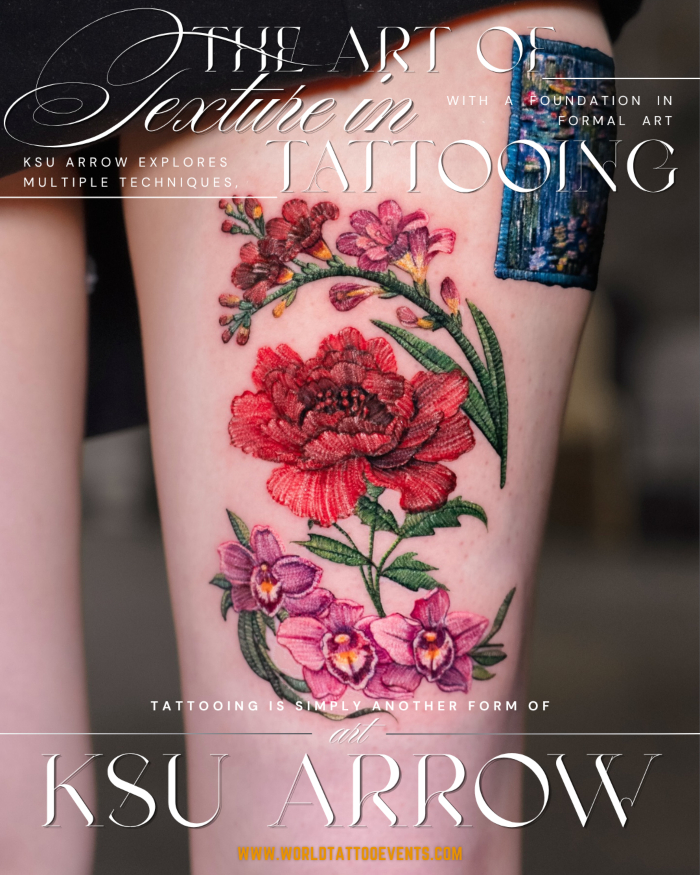
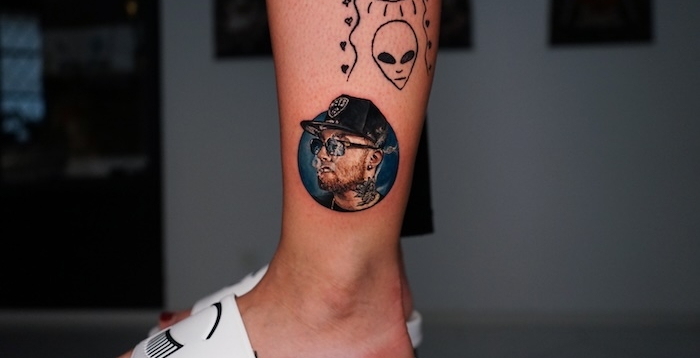
Her work is defined by technical experimentation and a focus on texture, ranging from embroidery and brushstrokes to sticker-like surfaces and micro-realistic compositions. Rather than committing to a single style, Ksu Arrow explores multiple techniques unified by one principle—recreating complex visual effects in a believable way on skin. This constant pursuit of challenge drives her process, where research, observation, and problem-solving take priority over speed or repetition.
Beyond technique, Ksu Arrow approaches tattooing with a grounded perspective, recognizing it as both creative work and profession. She emphasizes self-awareness, discipline, and the importance of understanding both art fundamentals and the physical reality of working with the body. Looking ahead, her focus is on bridging tattooing with contemporary art spaces, pushing the boundaries of what can be created on skin while reinforcing one core idea—tattooing is simply another form of art.
Let’s step into her world.
- How would you like to introduce yourself?
My name is Ksu Arrow. I’m a tattoo and fine art artist. One of my core beliefs is that tattooing is art—not a separate subculture or just a paid service, but an important part of the art world.
- Where can your customers find you?
I’m currently based in Los Angeles at Ink Garden Studio.
- How would you describe the tattoo scene in your country today?
I’ve only been in the U.S. for four years, so I can’t fully speak on the industry here. But from what I see, global events have brought many artists to the U.S., which has shifted the scene more toward art, rather than the traditional “tattoo parlor” culture that was dominant for a long time.
In my home country, Russia, tattooing originally came from prison culture. Because of that, many artists worked hard to separate themselves from those associations and push tattooing toward art. So the development there was quite different.
I haven’t been back in a few years, and the political situation has likely changed a lot. But one thing has always remained the same—quality comes first. If you want recognition and success, your work has to be strong.
- How would you define yourself in one word?
Challenge.
- Where did your fascination for tattoos begin?
I’ve been drawing my whole life, but I never planned to become a tattoo artist. It happened by accident. My partner started tattooing and kept encouraging me to try. Eventually, I did.
I was honestly scared at first, but I pushed through it. Once I started, I realized it wasn’t a completely different world—it was still art, just on skin instead of canvas.
- What does tattooing mean to you personally?
It’s my job, and it’s also part of my art. I don’t think it’s completely honest when artists say tattooing is their soul—it’s still work, and it pays the bills.
What makes it meaningful is that I can create art directly on someone’s body. I see it like selling a painting—someone buys it and hangs it in their home. With tattooing, they carry it with them.
- When did you decide to become a professional tattoo artist?
I started tattooing in 2013. There wasn’t a dramatic moment where I decided to become a professional—I just started, and quickly moved from working at home to working with clients in a more professional setting.
Because of my formal art education, the transition wasn’t too difficult. I already understood composition, color, and structure—I just had to apply it to skin.
- How did your family react to your career choice?
I was lucky—my close family isn’t strict. In Russia, tattooing has historically been associated with criminal culture, so a negative reaction would have been understandable.
Some distant relatives did say it was sinful or connected to crime, but my close family told me to do what I like and earn money how I want. They supported me, and I never had to fight for it.
- Did you go through an apprenticeship? How was that experience?
No, I didn’t go through a formal apprenticeship. I started tattooing at home in 2013, learning through YouTube and with some guidance from my partner, who had only been tattooing for about six months at the time.
He showed me some basics, but it wouldn’t be accurate to call it a traditional apprenticeship. I never followed a standard path.
- What did your first tattoo look like?
I still have a photo of it. It was a small wrist lettering for an eighteen-year-old couple that said: “Together Forever.” I really doubt they’re still together—but if not, their new partners can always get the same tattoo.
- Do you regularly do guest spots? If yes, what has your experience been like?
Yes, I’ve done many guest spots throughout my career. I started in Russia around 2016, but I don’t really count those the same way. I didn’t fully understand guest culture until I started working internationally in 2017.
Since then, I’ve traveled to more than 20 countries and over 60 cities, working in at least 40 of them. That includes much of Europe, parts of Asia, Latin America, the Middle East, and the U.S.
Guest spots can be very different depending on the purpose. Business-focused studios help you earn, but not necessarily grow. Art-focused studios may be harder financially, but you gain experience and connections.
It’s incredible knowing your work lives on people all over the world. But after almost ten years of traveling like this, I’m honestly tired. It’s physically demanding, logistically complex, and you rarely get to experience the places you visit. It’s amazing in the beginning—but over time, you feel the weight of it.
- What does a typical working day look like for you?
I rarely start before noon—I’m definitely a night person. I usually take only one client per day, unless it’s a small touch-up, and I try to work no more than three to four days a week.
I arrive at the studio around 12 PM, spend about two hours preparing, and then tattoo for three to eight hours with breaks. Afterward, I clean up, take photos, and take time to decompress.
- How do you determine the price of a tattoo?
I compare myself to artists with a similar level of quality, experience, and visibility.
Pricing has always been difficult, especially since I’ve worked in many different countries. You can’t charge the same everywhere—income levels vary too much. That makes it harder to adjust prices both up and down.
So I try to stay aligned with artists working at a similar professional level.
- What is the most challenging aspect of being a tattoo artist in 2026?
Marketing—definitely marketing.
There are more artists now, and many of them are strong, but the real challenge is presentation and advertising. Social media constantly changes, and it’s difficult to understand what actually works for you.
There’s no point copying others. What works for one artist may not work for another. You have to find your own way to attract clients—that’s the real challenge today.
- What is the most rewarding aspect?
For me, it’s knowing that my art lives on people all over the world. It’s not fixed in one place—it travels, changes, and becomes part of someone’s life.
- What tools and machines do you prefer to use?
I’ve been using Kwadron needles for about 7–8 years, and I’m now part of their team. During sessions, I use Inkeeze for skin care and preparation, and I work exclusively with World Famous inks.
For machines, I currently use FK Irons and Bishop. Previously, I also worked with Cheyenne.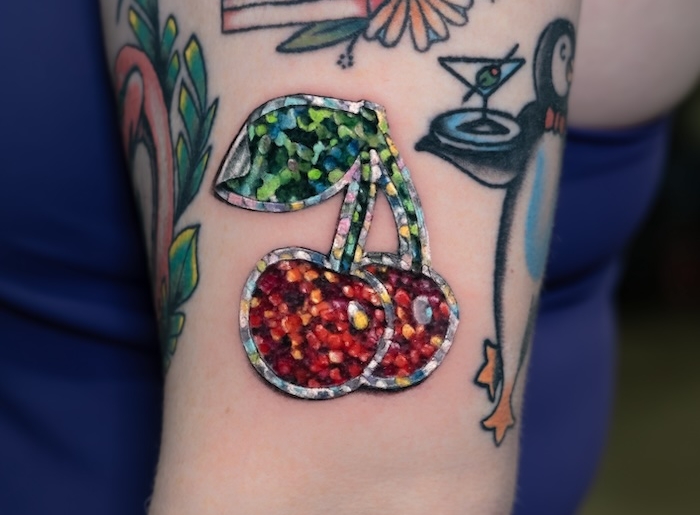
- What is your number one aftercare advice for clients?
Understand your own skin.
My aftercare instructions are very detailed, but the most important thing is that tattoo healing is like skincare. There’s no universal method—your skin type, health, and body all affect the outcome.
- How would you define your current style, and how did you develop it?
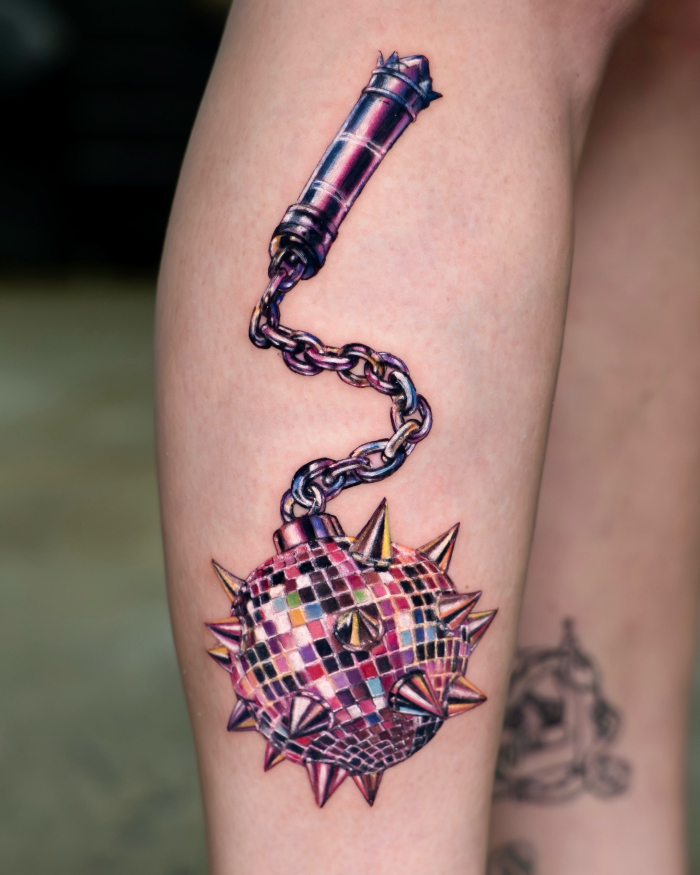
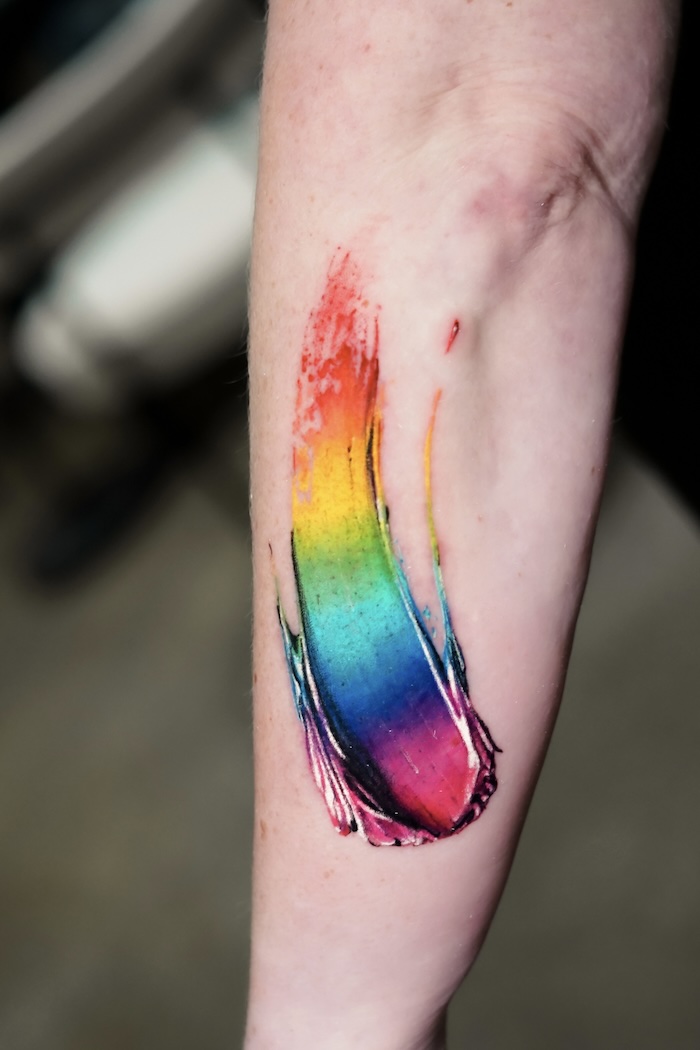
I work across six or seven different styles, but they are all connected by one core idea—recreating textures on skin.
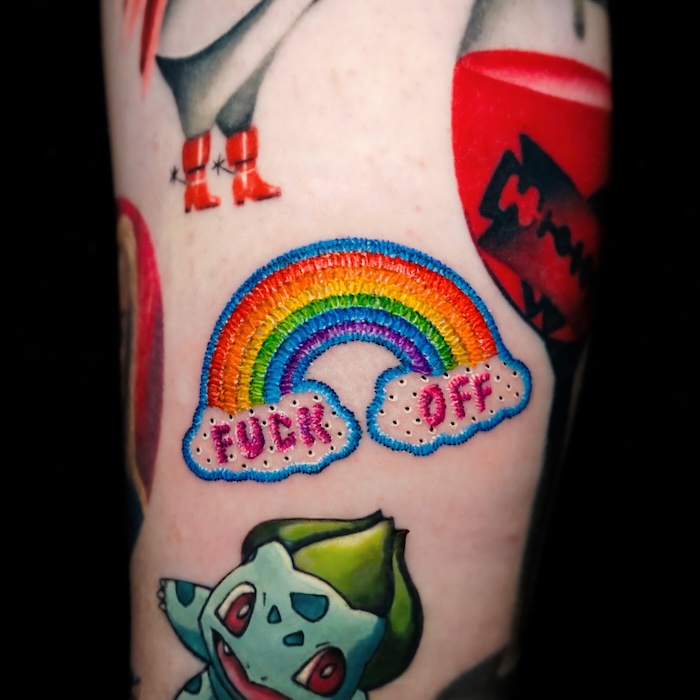
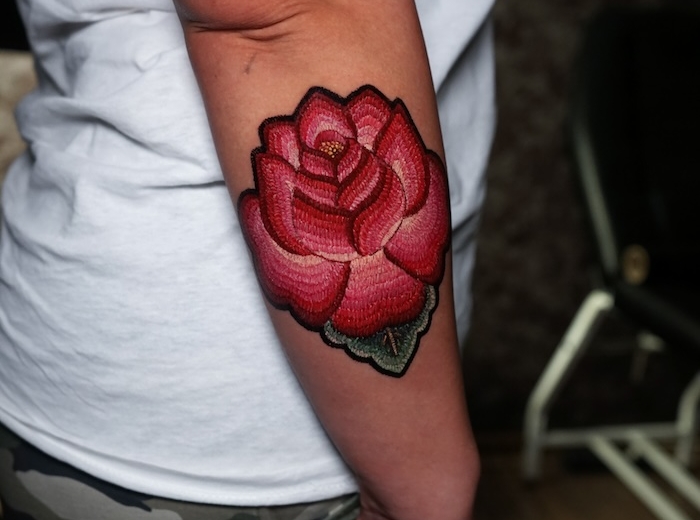
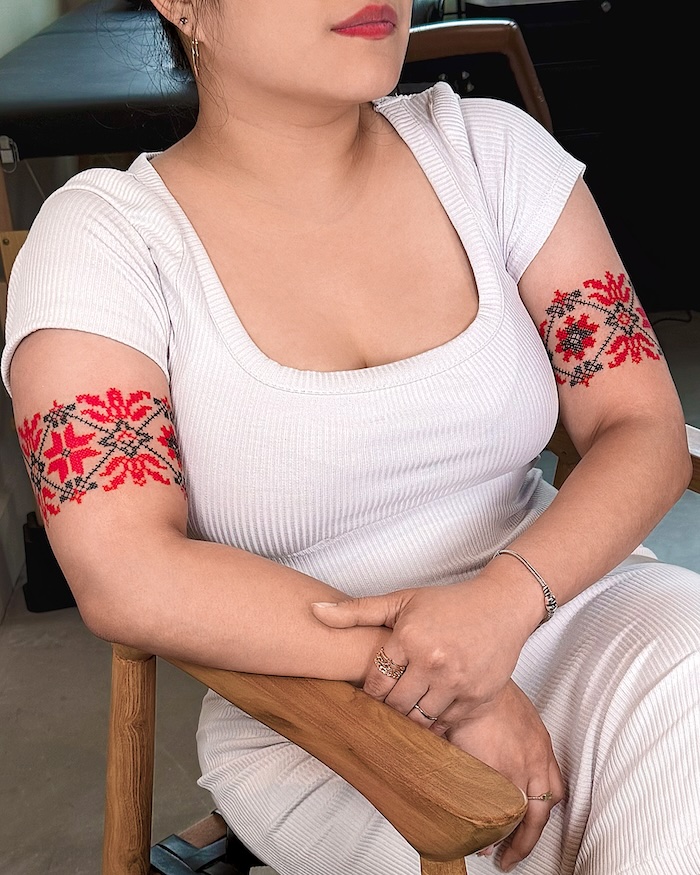
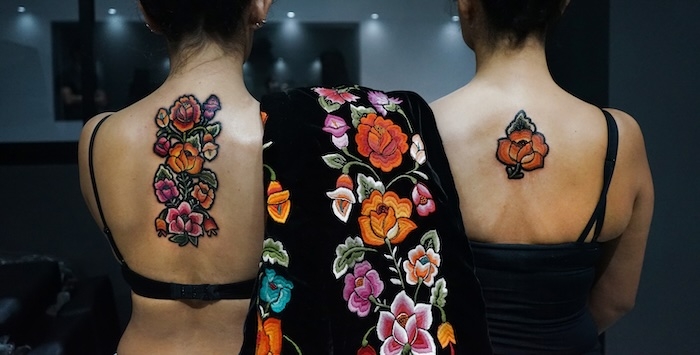
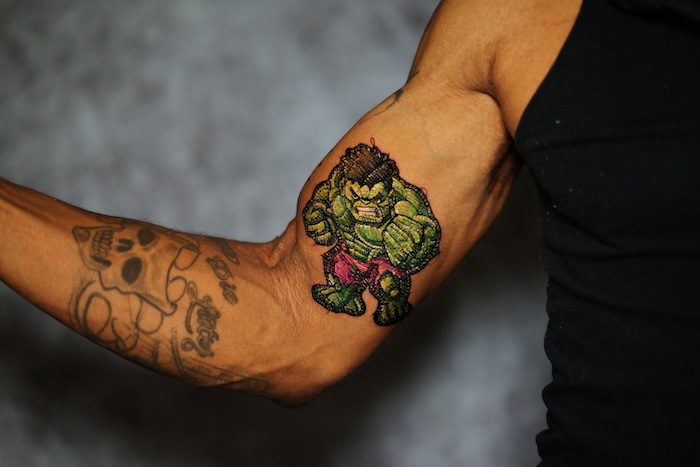
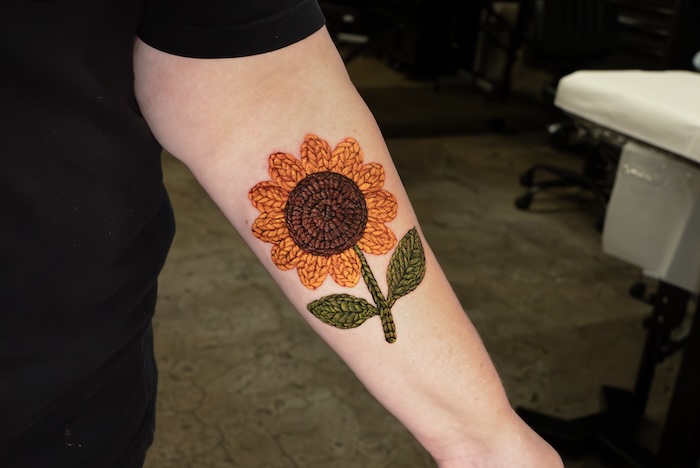
More specifically, I focus on translating real textures into tattoos. For example, embroidery—I use actual references like crochet, cross-stitch, and traditional stitching, and reinterpret them on skin.
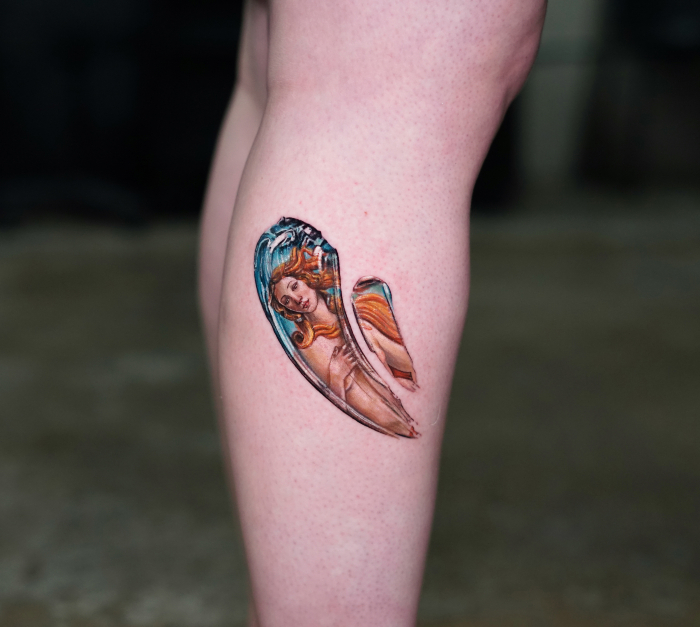
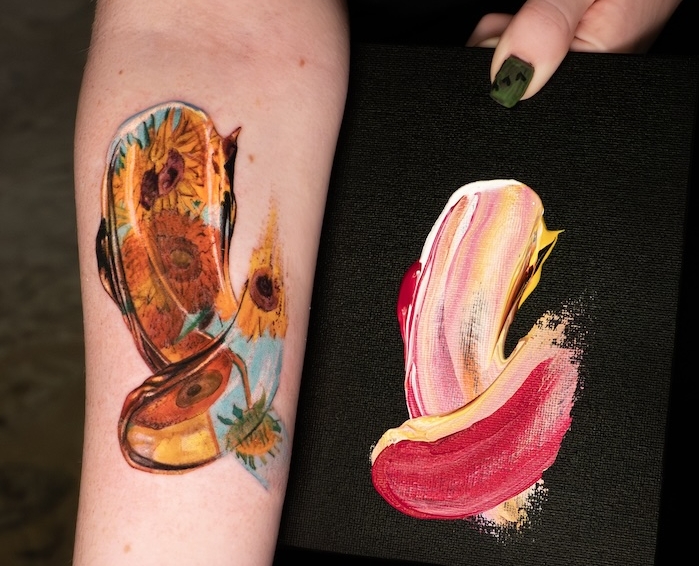
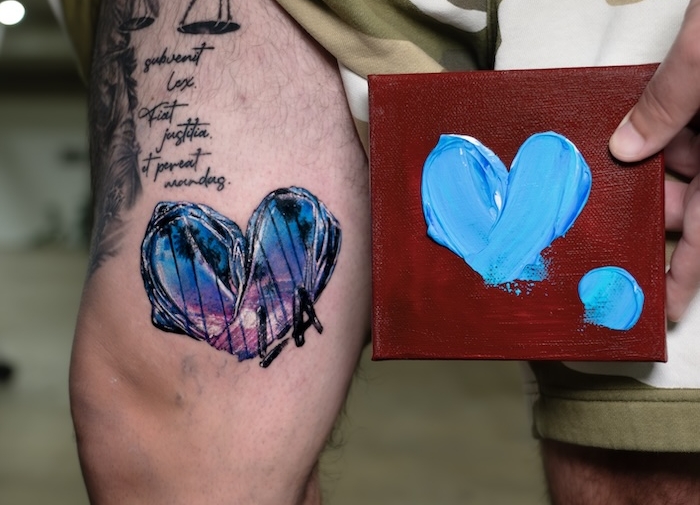
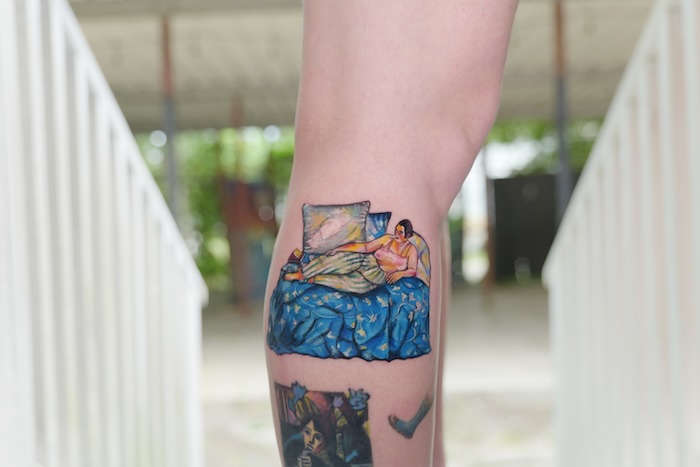
I also recreate paint brushstrokes by physically painting on canvas first, then transferring that effect onto skin, often incorporating an image within the stroke.
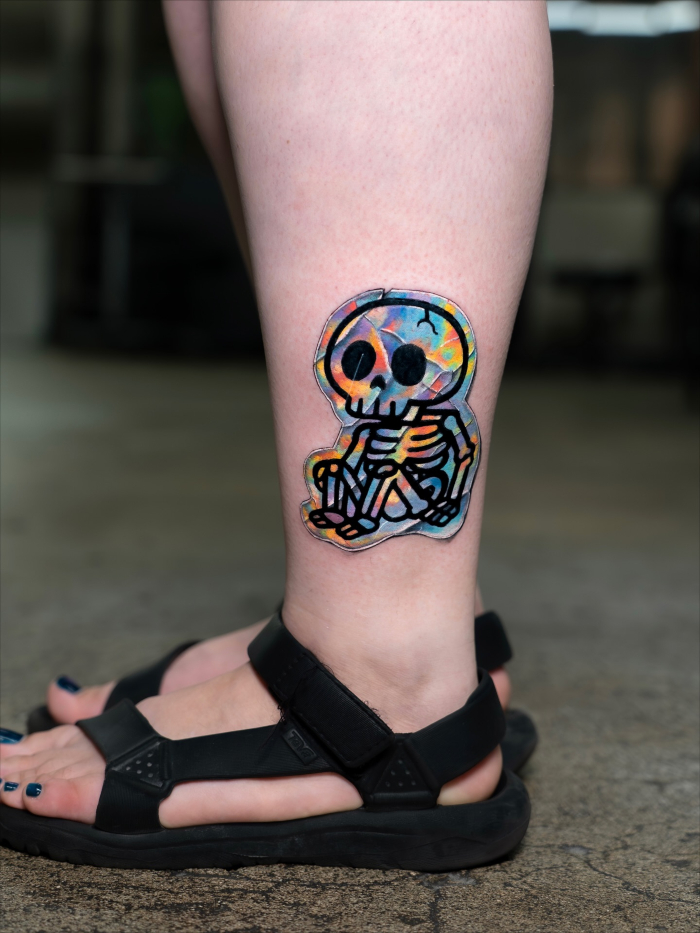
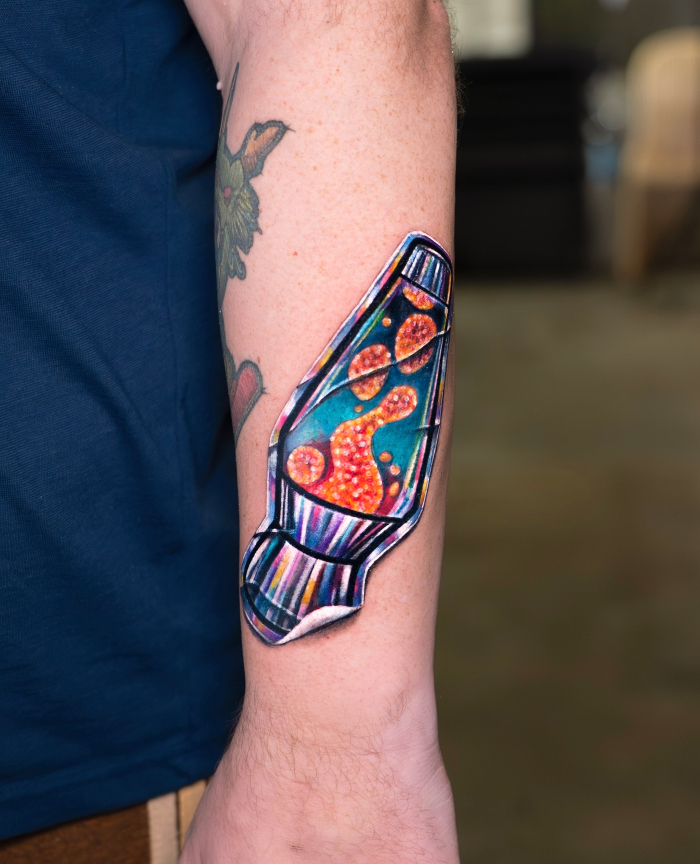
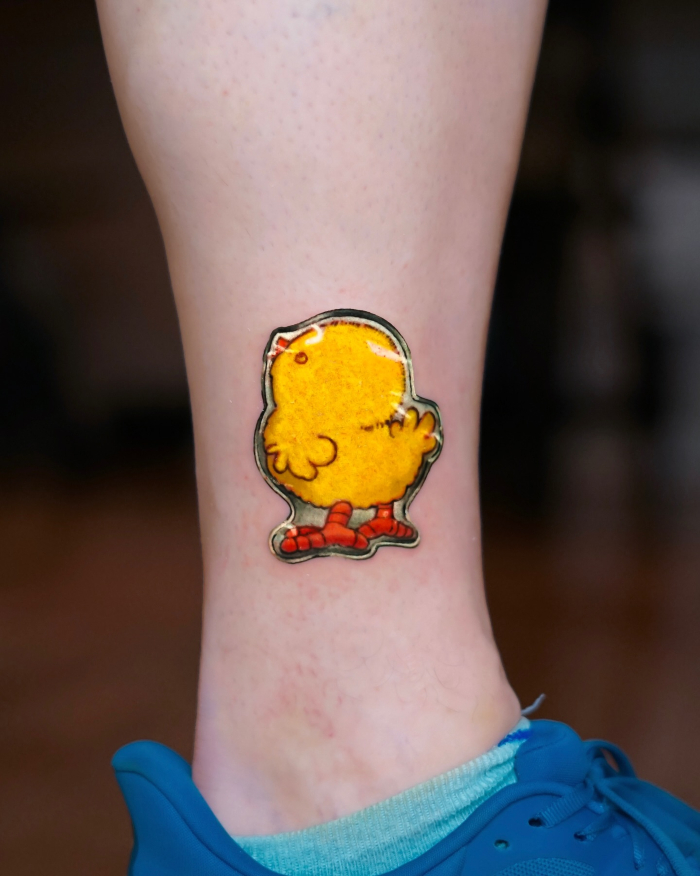
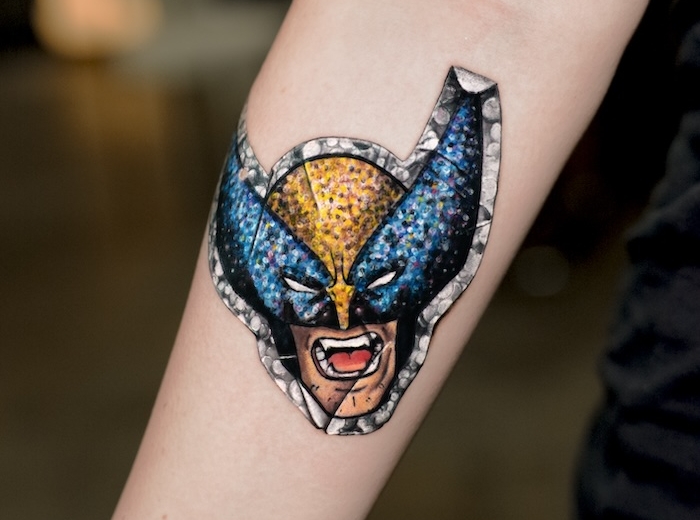
Another direction I explore is sticker-based work—sparkling stickers, holographic effects, and other variations. I also do painting reproductions, micro-realistic color tattoos, landscapes, and cover-ups.
But regardless of the style, the main idea stays the same—I’m interested in unusual tattoos that present a technical or visual challenge. I enjoy figuring out how to make something believable on skin.
- Walk us through your process when starting a new tattoo.
I try to understand as clearly as possible what the client wants. I don’t freehand, and I rarely design on the spot, except for some cover-ups—and even then, I prefer to have a consultation beforehand if possible.
I actually spend more time thinking than tattooing. A client contacts me, we discuss the idea, and I help them find the best way to execute it. If I feel the idea isn’t suited to my work, I recommend another artist.
I usually create the design the day before the appointment, but I only show it during the session. That’s because I need to see how it fits the actual body and adjust it accordingly.
- How do you stay creatively inspired?
Traveling, reading, and constantly learning. Even going somewhere new within the same city can be enough. Seeing something different is important. Social media also helps—not for copying, but for observing cultural shifts, visual trends, and what’s happening globally.
For me, inspiration comes from movement—either physical or intellectual.
- How do you balance client requests with your artistic vision?
I don’t work outside my styles. If a client’s idea doesn’t fit my approach and they’re not open to adapting it, I refer them to another artist.
But in most cases, I can offer a solution because I work across multiple techniques. I take the time to explain what I can propose and why it works better visually. In most situations, that approach works.
- Are there styles you would like to explore more in the future?
I want to push real texture even further—something unusual, something that makes people stop and think, “Wait… that’s possible as a tattoo?”
Everything has probably already been done in some way, but I still want to expand how texture can be translated onto skin.
- Are there tattoos you prefer not to do?
Yes—lettering.
Not because I dislike it, but because it’s not my strength. I only do it in very specific cases, like embroidery-style lettering, sticker compositions, or signatures.
For regular words or phrases, there are artists who specialize in that and can do it better.
- Do you have sponsors? If yes, please tell us about them.
Yes. I work with Kwadron needles, which I’ve used for 7–8 years, and I’m very happy to be part of their team.
I also recently joined the Inkeeze program, and I’ve been a fan of their products for many years.
- What tattoo ethics are most important to you?
Tattoo artists should never forget that we work with real people. Even if I approach skin as a canvas, it’s still a living body. Tattooing is painful and takes time, so I try to make the experience as comfortable as possible—offering breaks, maintaining a comfortable setup, and even simple things like having snacks available.
I’ve noticed an interesting shift over time. In the past, many artists weren’t strong at drawing, but they were strict about hygiene and medical standards. Now it often feels reversed—artists draw very well, but hygiene standards can be weaker.
Both are essential. You can’t choose one and ignore the other.
- How do you continue learning and improving your craft?
Draw, draw, draw—and study new approaches.
Masterclasses can help, but tattooing is still a technique. You can always improve it. At the same time, you need to improve your drawing skills, anatomical understanding, and awareness. As your overall level grows, your tattoos grow with it.
- Do you mentor or teach upcoming artists?
I’ve taught a few artists, but honestly, teaching is not really my thing.
- How do you stay at the top of your game?
I’m not afraid to try new things, even when they’re difficult. I want to understand how something works and how to execute it properly.
You also have to be able to criticize yourself. You need to see your mistakes and fix them. If you believe you’re already the best, you stop growing.
- What separates a good artist from a great one?
Self-awareness and discipline.
A good artist can produce solid work. A great artist can look at their own work honestly, recognize weaknesses, and keep improving without protecting their ego.
- How do you feel about the growing social acceptance of tattoos?
I think it’s natural. Tattooing was never meant to be just a subculture—it’s simply part of life.
For me, it’s no different from wearing jewelry. No one questions a bracelet, so it’s strange that people would question images on the body.
- What is the biggest misconception customers have about tattoos?
Those tattoos must have meaning or be tied to a specific lifestyle.
There are still stereotypes—crime, certain jobs, certain personalities. But in reality, tattoos are just images on your body. You can give them meaning if you want, but they don’t have to carry one.
- What major trends have you noticed in the past five years?
Trends are cyclical. There’s nothing truly new.
Styles come back in different forms. For example, tribal was huge in the ’90s, and now cybersigilism is popular—but structurally, it’s very similar. The same applies to many styles.
There’s no point chasing trends. It’s better to focus on what you want to do and grow in that direction.
- What is your opinion on AI in tattooing?
It’s complicated. AI can be useful for reducing research time or helping clients express ideas. I sometimes use it to improve low-quality references.
But for generating tattoo designs, I don’t like it. The results are usually weak, and you can almost always tell when something is AI-generated. In art, speed shouldn’t be the priority.
- If you could change one thing in the industry, what would it be?
Ego. There’s too much ego in tattooing—but honestly, it’s probably the same in most art industries.
- Do you practice other forms of art?
Yes, I paint. Before leaving my home country, I was preparing for exhibitions, but I had to leave everything behind. Now I’m starting again—painting, preparing for future shows.
For me, painting and tattooing are directly connected. It’s the same visual language, just different surfaces.
- What has been your experience with tattoo conventions?
Very mixed. Some conventions are incredible—focused on art, with strong artists and a good atmosphere. Others feel more like festivals, with less focus on quality, which I don’t enjoy.
So overall, it’s been a very dual experience.
- How do you prepare for conventions?
I prepare as if nothing will be provided. Some conventions are well-organized, but others offer almost nothing—not even basic setup. So I bring everything I might need: equipment, supplies, and even materials to make the space functional.
- What is your main reason for attending conventions?
At the beginning, it was about networking and visibility. Later, I was invited as a judge or featured artist.
I haven’t attended conventions for about five years, but I’m returning this year and am open to new invitations.
- What is your favorite convention so far, and why?
Macao in 2019. It took place inside a huge casino with a recreated Venice environment. The setting, the artists, and the atmosphere made it a very memorable experience.
- Have you participated in tattoo contests?
No. I don’t really believe in competing in art. Comparing styles or techniques doesn’t make much sense to me—too many factors are involved, including the client’s skin and healing process.
- What is your greatest accomplishment so far?
I’ve grown stronger in my styles, and I’m proud that I can work with any skin tone and make color work well.
I’m also proud that I can cover or fix a large percentage of existing tattoos, and that I have many healed works over six years old that still look strong.
- What advice would you give to someone considering a career in tattooing?
First, understand how much you like working with people. Tattooing is a constant interaction.
Second—draw a lot and learn fundamentals.
Third—study anatomy and hygiene. You’re working with a living body, not just a surface.
- What are your goals for the near future?
I want to exhibit in galleries, create art performances, and move more into contemporary art spaces.
For me, tattooing and painting are not separate—I want to develop that connection further.
- What legacy would you like to leave as an artist?
I want to show that almost anything can be recreated as a tattoo. There are no real creative limits—only technical ones that need to be understood and respected.
- What final message would you like to share with our readers?
Tattooing is part of art. It doesn’t have to belong to a subculture unless you choose it to. It doesn’t need heavy meaning unless you give it one.
For artists, don’t limit yourself creatively.
For clients—understand that what you put on your body is still art.


Leave A Comment