

Drawing from over 400 years of Japanese tattoo history, IVOLY defines his practice as an imagined evolution of tradition, what he calls Alter Traditional and Missing Tales. Through extensive research into ornamental references, rare texts, and forgotten narratives discovered in antiquarian bookstores, his tattoos give form to stories that have never been visualized before. Each piece is developed slowly, guided by careful listening, responsibility, and the belief that a tattoo is completed through the shared commitment of both artist and wearer.
Based in Osaka and working without a fixed base, IVOLY approaches tattooing as a cultural responsibility rather than a commercial product. For him, tattoos are not decoration, but records. Marks that carry spiritual, historical, and personal meaning across time. Through initiatives such as BAY GATE and HEISEI Tattooer Gallery, and with the upcoming launch of the Osaka Tattoo Museum (O.T.M.), he is actively creating platforms to pass down mindset, ethics, and technical spirit to future generations. This interview offers a rare and thoughtful look into an artist who views tattooing not as a trend, but as a living cultural lineage—one that must be protected, questioned, and carried forward with care.
How would you like to introduce yourself? Where can your customers find you?
Hello, my name is IVOLY, and I am a tattoo artist based in Osaka, Japan. Together with my wife, SINK who is also a tattoo artist, I currently run a tattoo studio. In mid-2026, our studio will relaunch under a new name and concept as the Osaka Tattoo Museum (O.T.M.).
How would you describe the tattoo scene in your country these days?
In Japan, tattooing was legally recognized a few years ago, which led to a rapid increase in the number of tattoo artists. At the same time that social prejudice has decreased, tattooing has also become increasingly commercialized and treated as fashion.
I feel this is one of the most significant turning points in the 400-year history of Japanese tattooing. Because of this shift, I strongly believe that we now need a place dedicated to preserving and communicating the cultural and spiritual aspects of tattooing, especially within an industry that is accelerating commercially. That belief is what led me to conceptualize O.T.M.
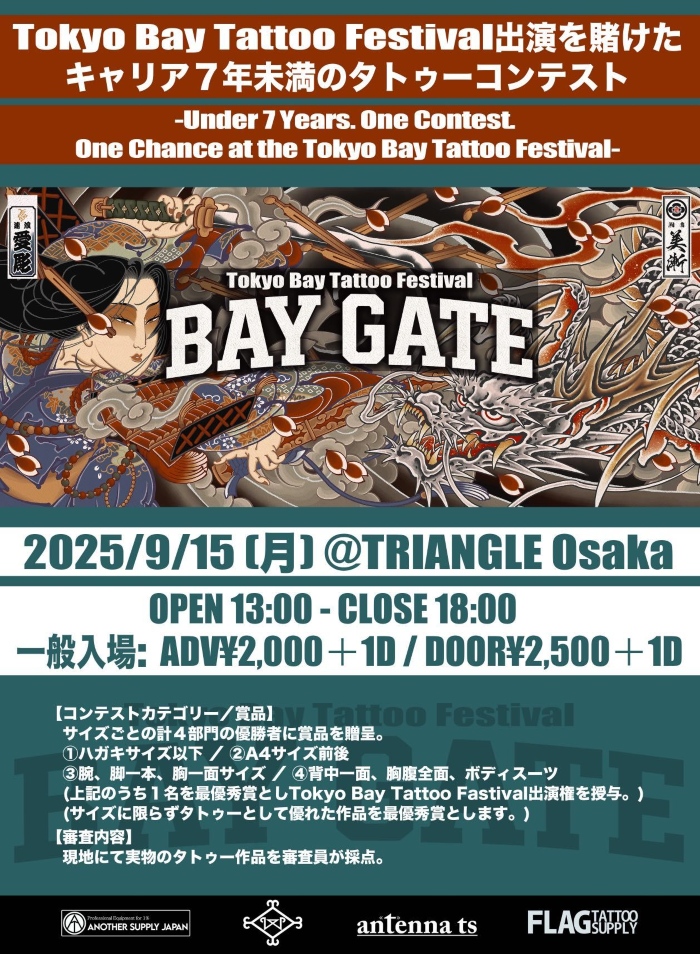
Last year, I also organized two projects: BAY GATE, a tattoo contest limited to artists with less than seven years of professional experience, and HEISEI Tattooer Gallery, a group exhibition exclusively for artists of the Heisei generation (those born in or after 1989). I believe these platforms serve as rare and meaningful spaces, both domestically and internationally, to re-examine technical skill and the spirit of craftsmanship within today’s tattoo scene.
How would you define yourself in one word?
As I mentioned in my 2024 interview with KING OF TATTOO, my goal is not to become “the richest” or “the most famous” tattoo artist in history. My goal is to become the artist who has contributed the most to culture.
In the two years since I first expressed this belief publicly, I’ve been deeply grateful to see the number of collaborators, both in Japan and abroad, who resonate with this philosophy continue to grow.
Where did your fascination for tattoos come from? At what point in your life did you decide to become a professional tattoo artist?
Twenty years ago, when I was 17, I was deeply drawn to both traditional Japanese craftsmanship and street culture. At that time, tattooing was still very much underground in Japan, and it was during that period that I decided to pursue the path of a tattoo artist.
What does tattooing mean to you personally?
In modern times, tattooing has often symbolized rebellion. In ancient Japan, however, it was closely tied to nature worship and spiritual beliefs. While much of that original awareness has been lost today, the more I study and learn, the more my understanding of tattooing continues to evolve and deepen within me.

How did your family react when you started a career in tattooing?
Although my mother supports me now, she strongly opposed my decision at the time and even cried. My father passed away when I was very young.
Her fear came from a deeply rooted stereotype in Japan: “Tattoos equal yakuza,” which implied social exclusion from mainstream society. Even today, my wife’s parents are unaware of our profession. This was a decision we came to together after struggling with the issue for three years, up until our wedding.
Did you go through an apprenticeship? How was that experience?
Rather than apprenticing under a single master, I visited the studios of many renowned tattoo artists. By receiving tattoos on my own body, I learned not only technique, but also the mindset and spirit behind the craft.
What did your first tattoo look like?
The first tattoo I ever made was on my own finger. It was a declaration of my decision to step away from conventional society and commit to living as a tattoo artist.
Do you usually do guest spots? If yes, what’s your experience in doing them?
In Japan, I work regularly in Tokyo during the first week of every even-numbered month. Internationally, I’ve recently formed strong connections in countries such as France and Germany, and I expect to continue guest working abroad more frequently in the future.
As a tattoo artist, what does your daily working routine look like?
In recent years, I haven’t been able to make time for it, but I would like to return to training at a martial arts dojo and the gym that I used to attend.

What is one surprising aspect of being a tattoo artist?
What surprised me most is that, despite Japan’s roughly 400-year history of tattooing, active exchange and interaction among tattoo artists only began about 20 years ago.
How do you determine the price of a tattoo?
I base my pricing on traditional Japanese tattoo pricing standards.
What’s the most challenging aspect of being a tattoo artist in 2025?
One of the biggest challenges today is that artists are judged not only by the quality of their work, but also by their ability to promote themselves on social media. As the barrier to becoming a tattoo artist has lowered, more people are entering the field, but just as many are quitting.
As a result, it has become harder for serious, dedicated craftsmen to consistently receive work. I also see many artists being tempted by short-term visibility and instant fame, which I believe is another major issue in the current scene.
What’s the most rewarding aspect of being a tattoo artist?
I feel the greatest sense of fulfillment when I create a strong design, when the client who wears it is truly happy, and when that tattoo eventually comes to hold meaning within the broader tattoo scene.
What tools and machines do you prefer to use?
I use both coil (magnet-type) machines and pen-type machines, along with tools that I have custom-made myself.

What’s your number one aftercare advice for clients?
The most important thing I emphasize is understanding that a tattoo is not created by the artist alone, it is something completed through the shared responsibility of both the client and the artist.
How would you define your current tattoo style, and how did you end up focusing on it?
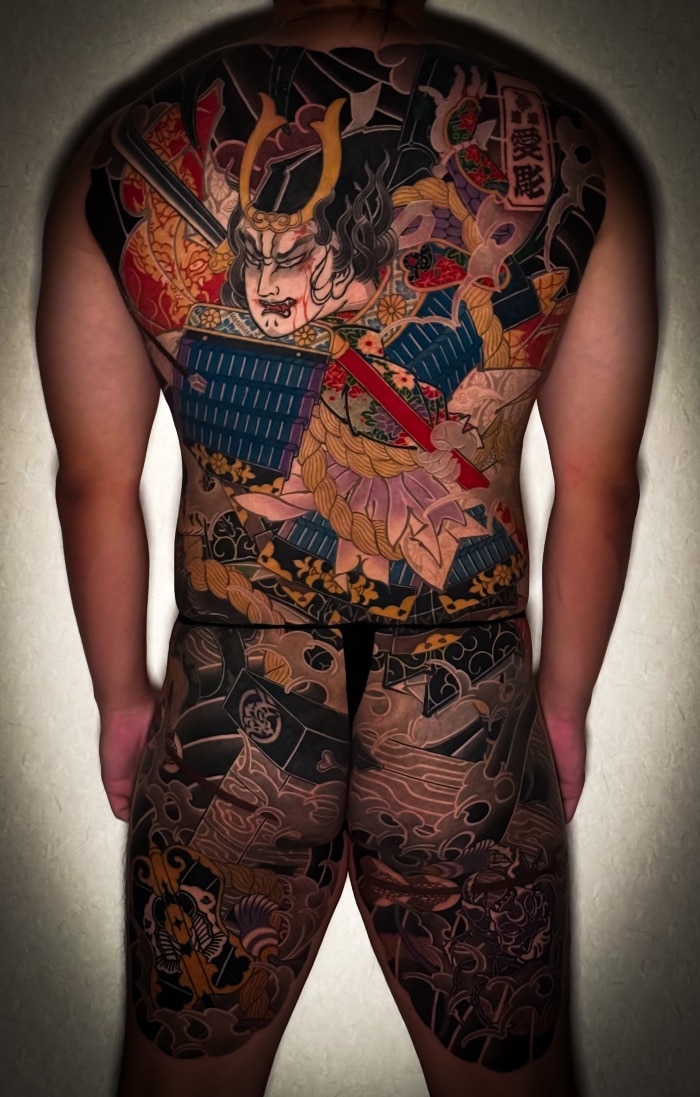
I define my style as “an evolution that might have existed as an extension of traditional Japanese tattooing.” When I began working as a tattoo artist, both traditional methods and futuristic Japanese styles had already been extensively explored. I started searching for a frontier that my generation could still open. Through that process, I came to believe that two ideas held the potential to expand the definition of tattoo genres and become cultural assets worth preserving for the future: Traditional tattoos that might have existed in an alternate timeline, and stories that have never been used as tattoo motifs. I named these two projects Alter Traditional and Missing Tales. My work can be categorized into one or both of these concepts, and I plan to exhibit the reference materials that informed these works at O.T.M.
Please walk us through your process when you start a new tattoo for your customers.
For Alter Traditional, inspiration comes from traditional ornamental references from Japan and other parts of Asia that I’ve collected over the years. For Missing Tales, the process begins by visiting antiquarian bookstores throughout Japan, searching for written materials that can serve as tattoo motifs.
Most of these references cannot be found online, which gives them a value that could be described as something even AI cannot answer.
How do you stay creatively inspired?
My wife, SINK, is growing at an incredible pace, winning two major titles at domestic conventions last year and being selected to appear at GODS OF INK this year. Living alongside her, my creative drive never fades.
How do you balance client requests with your artistic vision?
Most of my clients allow me a great deal of creative freedom. I usually only ask for general preferences, such as size, color range, and the nuance of the main motif.
Are there any tattoo styles you’d like to explore more?
I would like to depict legends and folklore from around the world, not only Japan, that have yet to be visualized, using my own style.
What’s the most underrated tattoo style?
Tribal and indigenous tattoo cultures from various regions are often undervalued. In Japan, examples include Hajichi from the Ryukyu people and Sinuye from the Ainu culture.
What’s the most overrated tattoo style?
Styles often labeled as “fully hand-poked” can be overvalued. What truly matters is whether the unique strengths of hand-poking are actually expressed. Overevaluation driven by social-media-friendly visuals is one of the issues within our industry.
Are there any tattoos you prefer not to do?
There are no motifs I actively avoid. However, I strongly hope that tattoo fans overseas will discover a broader range of Japanese narratives. Epic stories such as Suikoden and Hakkenden could become extraordinary tattoo subjects—this is also one of the messages I plan to share through O.T.M.
Do you have sponsors? If yes, what could you tell us about your sponsors?
At present, I am sponsored by a single company, EMALLA, while my wife has three sponsors. With the launch of O.T.M., I believe collaborators will emerge not only from tattoo supply companies, but also from cultural and traditional fields.

As a tattoo artist, what kind of tattoo ethics are really important to you?
As a Japanese tattoo craftsman, I have expressed the ethical values I hold dear through ten guiding principles. Looking at them as a whole, I realized that they closely resonate with ethical philosophies such as Taoism and Bushidō. I plan to share these principles through social media and O.T.M. in the future.
Being a successful tattoo artist requires many different skills. What’s your favorite way to keep learning?
The master Horiyoshi III, who tattooed me fifteen years ago, once said, “There is no end to a tattooer’s training and learning.” I believe these words will continue to guide me for the rest of my life.
Do you like to teach or mentor upcoming artists?
In addition to training apprentices in my own studio, I have also conducted seminar-style instruction on occasion. In all of these efforts, I place equal importance on mindset and spirit, alongside technical skill. BAY GATE and HEISEI Tattooer Gallery are spaces created precisely for this purpose.
What’s the best piece of advice you ever received to improve your tattooing technique?
When you are young, emotions like jealousy or anger can sometimes become fuel. But those emotions only exist in relation to others. That is why I was advised to place myself in an environment where I can truly immerse myself in what I love.
How do you stay at the top of your game?
When I meet the masters I respect, I see that they are still practicing and growing every day. Watching their example naturally pushes me to live and work the same way.

What do you think separates a good tattoo artist from a great one?
What makes a good artist differs from client to client. A great artist, however, is not defined by awards or records, but by becoming a symbolic presence, someone who continues to influence people. My senior, HORIKEN, has received the highest honors in the world, yet lives with deep habakari, humility and restraint, and never puts himself forward. To me, his way of being represents the true spirit of the Japanese craftsman.
How do you feel about the growing acceptance of tattoos in society?
In Japan, social acceptance is expanding and prejudice is gradually decreasing. However, it was precisely that strong prejudice that pushed Japanese tattoo culture toward extreme refinement, such as full-body suits. That history is now being overwritten. I do not wish for discrimination to continue, but I believe the aesthetic sensibility and resolve of those generations must be recorded and passed on.
What’s the biggest misconception that customers may have about tattoos?
In Japan, there is still very little accurate understanding of tattoos. That is why I believe how our industry conducts itself from now on is extremely important.
What’s the biggest trend in tattooing you have noticed in the last five years?
After legalization, American traditional styles spread first. At present, realism is the most popular style. South Korea is also moving toward legalization, and as neighboring countries, we will inevitably influence each other and hopefully grow together.
What’s your view on the rise of AI in tattooing?
Tattoo artists have always been creators of counter-movements. Thinking about how to turn AI to our advantage is something I genuinely look forward to.

What would you change about the tattoo industry?
I want to see the revival of the Japanese tattoo industry, which was once called the best in the world.
Do you work on other projects within the tattoo industry?
I also accept commissions to create artwork for traditional Japanese events and local festivals.
Do you do other forms of art besides tattooing?
If viewed as counter-actions toward society, BAY GATE and HEISEI Tattooer Gallery could also be considered art projects.
Who are the people you admire the most within the tattoo community?
I have studied Japanese tattoo artists spanning the past 400 years, so it is impossible to name them all. That said, the person I respect most as a human being is my wife, SINK.
What’s your experience at tattoo conventions so far?
In addition to conventions in Japan, I mainly participate in tattoo conventions across Europe.

How do you usually prepare for a tattoo convention?
For conventions in Japan, many of the people who purchase tickets from me are young tattoo artists. For that reason, I prepare a ZINE for each event as a ticket benefit, containing information I do not share on social media.
What’s your primary reason to attend a tattoo convention?
The Japanese tattoo industry is still quite closed in many ways. I aim to act as a bridge, bringing overseas developments into Japan, while sharing Japanese tattoo culture with the world.
What’s your favorite tattoo convention so far? And why?
KING OF TATTOO is regarded as the highest-level convention in Japan, while Tokyo Bay Tattoo Festival is the largest. The Kanazawa Tattoo Festival left a particularly strong impression due to its deeply Japanese concept. I also have vivid memories of performing at the WILD TATTOO SHOW in Namur, Belgium.
Have you ever participated in tattoo contests?
Yes. Major awards include:
Tokyo Bay Tattoo Festival 2024 – 1st Place, Sleeve Category
WILD TATTOO SHOW 2025 – 1st Place, Ornamental Category
Tokyo Bay Tattoo Festival 2025 – Double Award, Sleeve Category (1st Place: SINK / 2nd Place: IVOLY)
DGN TATTOO MAG – 1st Place, Oriental Color Category
NANIWA INK EXPO – 1st Place, Japanese Back Piece Category
How do you think tattoo conventions could improve for both artists and the public?
Events like The Kanazawa Tattoo Festival can serve as vital spaces for passing down cultural traditions that are at risk of being lost.

Was there any event that really boosted your career?
The ISAMI Group Exhibition in 2022, organized by Jiro Nakano, was a milestone for me. Being selected to exhibit alongside legendary Japanese artists was one of the most meaningful moments of my career.
Is there any tattoo you have created that you are particularly proud of?
Every piece created under Missing Tales represents a story that deserves to be carried into the future. They are special not only to me personally, but also to the tattoo industry as a whole.
What is your greatest accomplishment as a tattoo artist?
The events I organized in 2025, BAY GATE and HEISEI Tattooer Gallery, became meaningful initiatives for Japan’s new generation of tattoo artists. I believe they will continue to grow into a larger movement.
What advice would you offer to someone considering a career as a tattoo artist?
When you are young, emotions like jealousy or anger can become energy. However, I hope you follow the spirit of the tattooer, what I call TATTOOMAN-SHIP, and never stray from a sincere path of craftsmanship.
What are your goals or dreams for the near future?
Alongside refining my own skills, my immediate goal is establishing the Osaka Tattoo Museum (O.T.M.). I hope it will become a bridge between generations and cultures.

What legacy do you want to leave as a tattoo artist?
I want to carry the spiritual foundation of 400 years of Japanese tattoo history into the present and help restore Japan’s tattoo culture to its rightful place.
To close this interview, what’s your last message to our readers?
The Japanese tattoo scene is entering a new era of awakening. While some figures stand out loudly, many remarkable artists are steadily growing beneath the surface. Please look forward to the future of Japan’s tattoo industry.


Leave A Comment